Niche Decode #004 – printable wall art
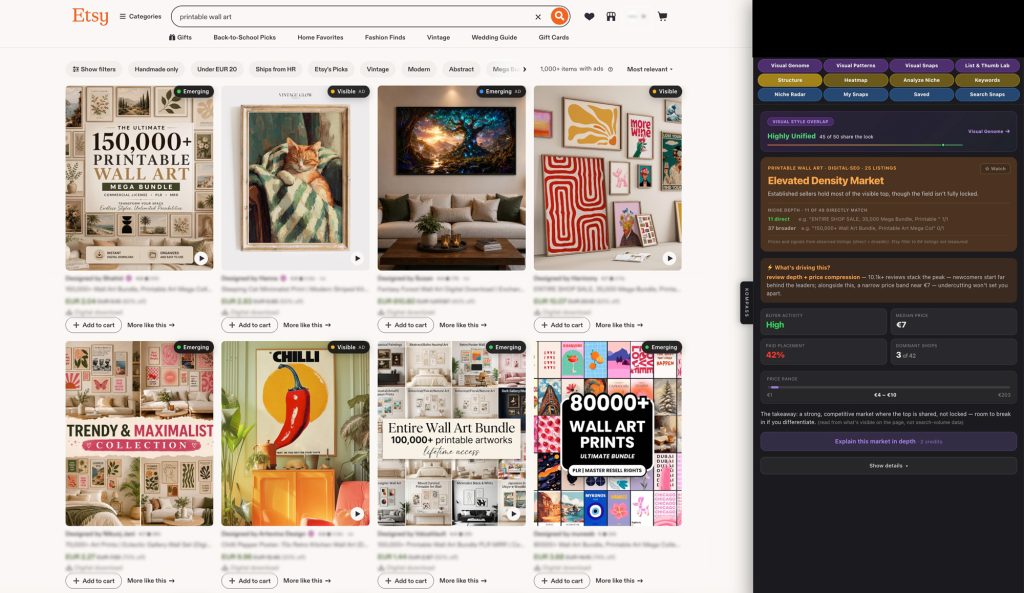
Printable Wall Art promises the cleanest business model on Etsy — design once, sell an instant download forever, no stock, no shipping. The market data reframes that promise: demand is real, but the field is dense, prices are compressed toward the floor, and the top of the page is shared between proven bundle sellers and paid placement.
45 of 50 visually analysed listings share the dominant look, so this niche is visually locked, not fragmented. That is the defining fact of the category: buyers scroll a wall of near-identical busy, lifestyle-staged mega-bundle thumbnails. Blending in is the trap — a distinct visual lane is the only real opening.
Let’s decode the niche — break the market down.
Remove the titles and shop names and the thumbnails still look like one seller — the market runs on a single, tightly repeated visual formula.
-
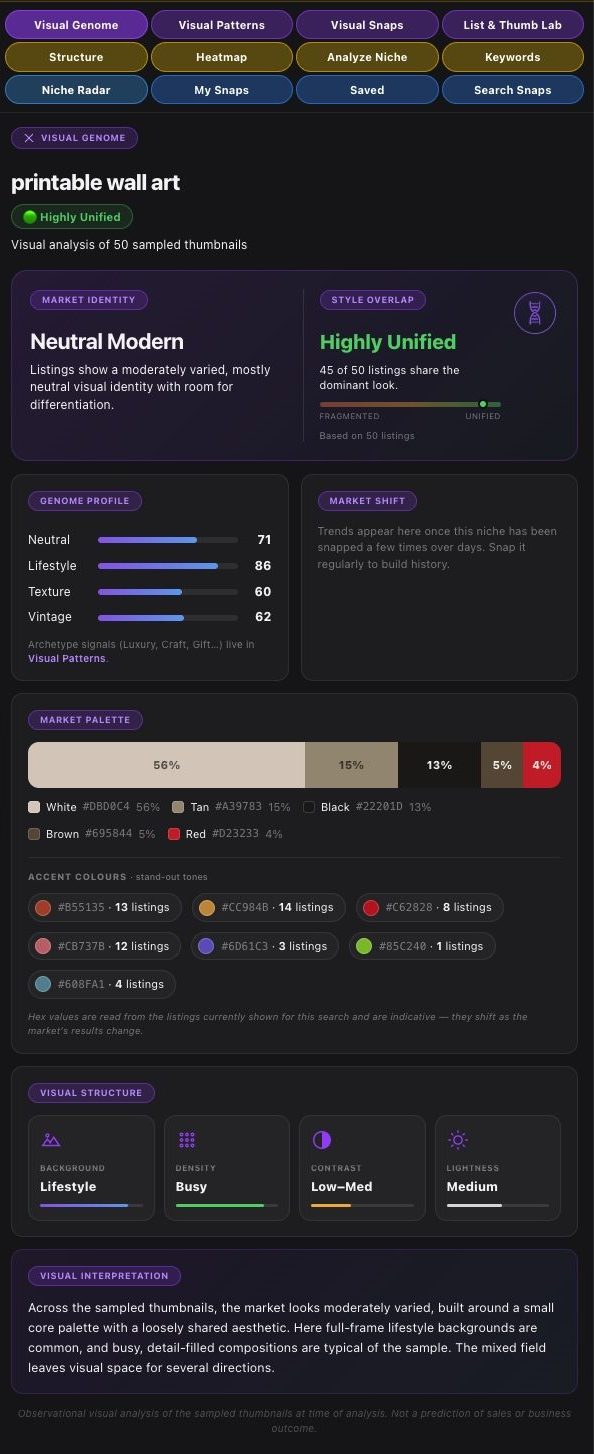
What it measuresWe analysed 50 thumbnails buyers encounter when searching for Printable Wall Art. Their palette, background, composition, texture and lighting form the niche’s Visual Genome.
-
Key insightThe market identity is Neutral Modern, and Style Overlap is Highly Unified: 45 of 50 listings share the dominant look. White leads the palette at 56%, followed by tan at 15%, black at 13%, brown at 5% and red at 4%. Genome signals run high on Lifestyle (86) and Neutral (71), with Vintage (62) and Texture (60) close behind. Backgrounds are lifestyle, compositions busy, contrast low–medium.
-
Why it mattersWhen almost every thumbnail wears the same neutral, gallery-wall costume, matching the market makes you invisible. The opening is not another beige mockup — it is a legible, single-subject aesthetic (vintage botanical, scientific engraving, bold graphic) that reads instantly against a wall of sameness.
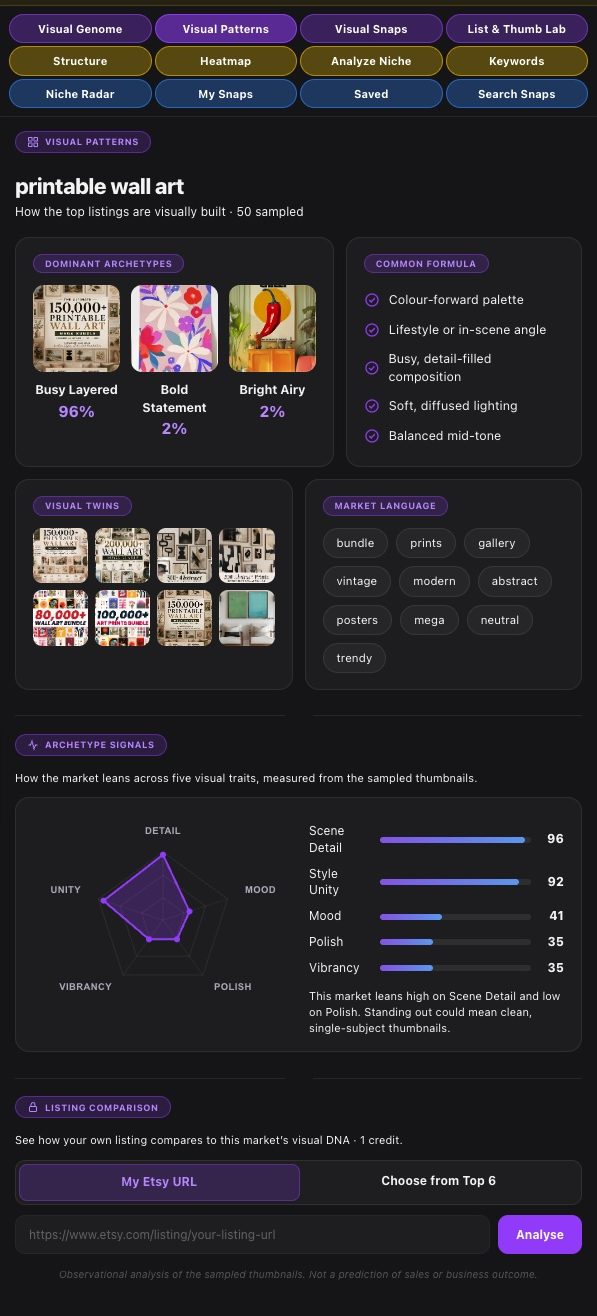
One archetype does not just lead this market — it very nearly is the market.
-
What it measuresWhen we grouped the listings by visual characteristics, the recurring patterns revealed the repeatable formula the market rewards — and how narrow it has become.
-
Key insightBusy Layered dominates at 96%, with Bold Statement and Bright Airy at just 2% each. The common formula is colour-forward palette, lifestyle or in-scene angle, busy detail-filled composition, soft diffused lighting and balanced mid-tone. Archetype signals confirm it: Scene Detail 96 and Style Unity 92, against Mood 41, Polish 35 and Vibrancy 35.
-
Why it mattersHigh Scene Detail with low Polish is the market’s blind spot. A clean, well-lit, single-subject thumbnail with genuine finish quality breaks the busy-collage pattern instantly — the rare frame that looks like a considered product rather than a crowded catalogue.
Strong demand keeps the door open — but structure shows how compressed the economics behind that door really are.
-
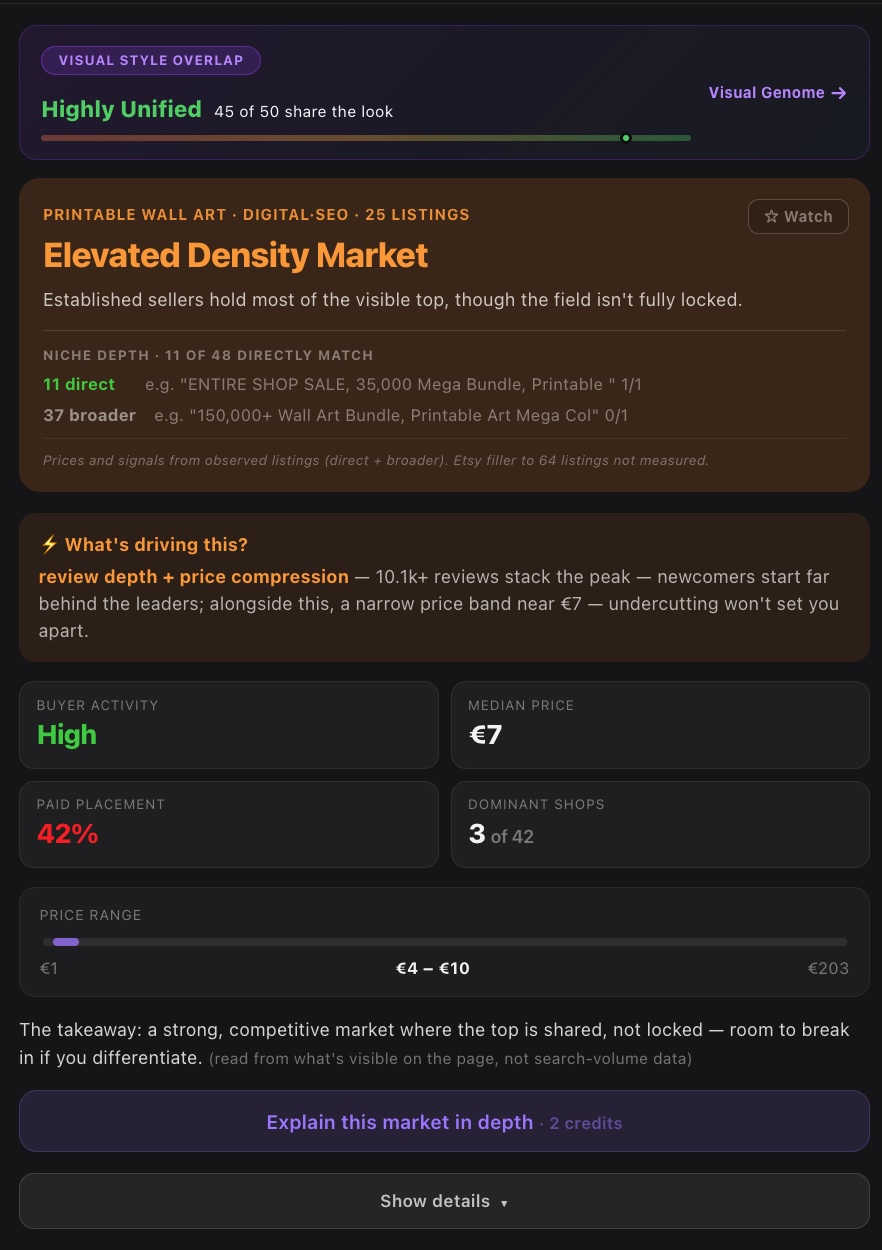
What it measuresHow concentrated the competition is — whether a handful of large shops dominate the first page, or there’s still room for differentiation. Listing count alone rarely tells the full story.
-
Key insightThis is an Elevated Density market with high buyer activity. Five dominant shops appear across 42 observed shops, and review depth at the top reaches roughly 10.1k. The median price is €7; the visible core sits around €4–€10, while the broader observed range stretches from €1 to €203 — driven by mega-bundles at the high end.
-
Why it mattersThe field is competitive but not closed — zero-review listings still surface in visible positions, so relevance and differentiation can break through. The real barrier is not entry, it is margin: a €7 median and a floor near €1–€3 mean price is not where you win. Perceived value and a defensible niche are.
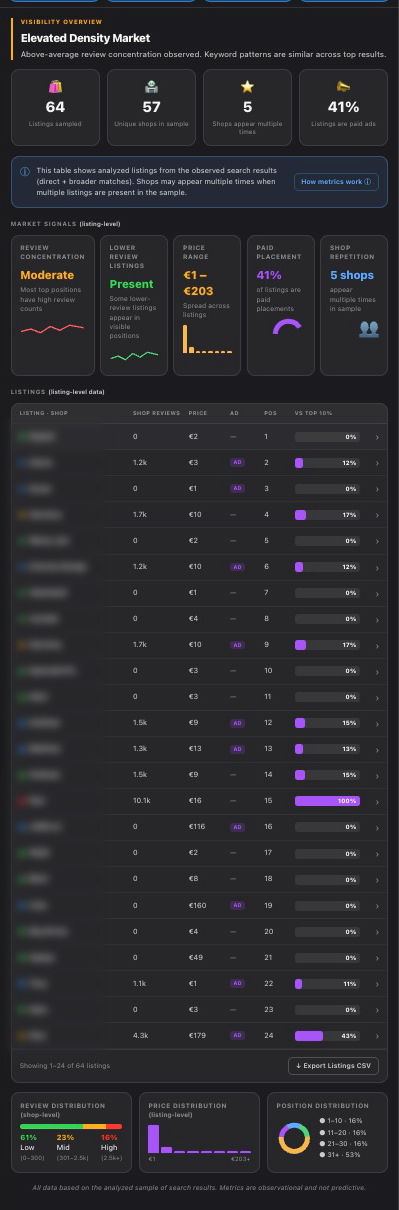
Visibility, review concentration, paid placement and shop repetition — mapped across 64 observed listings.
-
What it measuresWhere visibility sits across the sample: how reviews, prices, ads and repeat appearances change from the top positions into the lower results.
-
Key insightThe heatmap records Moderate review concentration, 57 unique shops, five shops appearing multiple times and 41% paid placement across 64 listings. Review distribution is bottom-heavy — 61% low, 23% mid, 16% high — and 53% of listings sit at position 31 or lower, confirming a long tail beneath a shared peak.
-
Why it mattersNewcomers compete against both accumulated trust and advertising spend. With a €7 median and 41% of results paid, the durable route is not outbidding — it is a distinctive use case, a genuinely different visual lane, and a thumbnail that signals finished quality at a glance.
From raw signals to a decision: what this high-supply, low-price digital market is telling a seller who wants in.
-
What it measuresA plain-language reading of what the sample means for a seller deciding whether and how to enter.
-
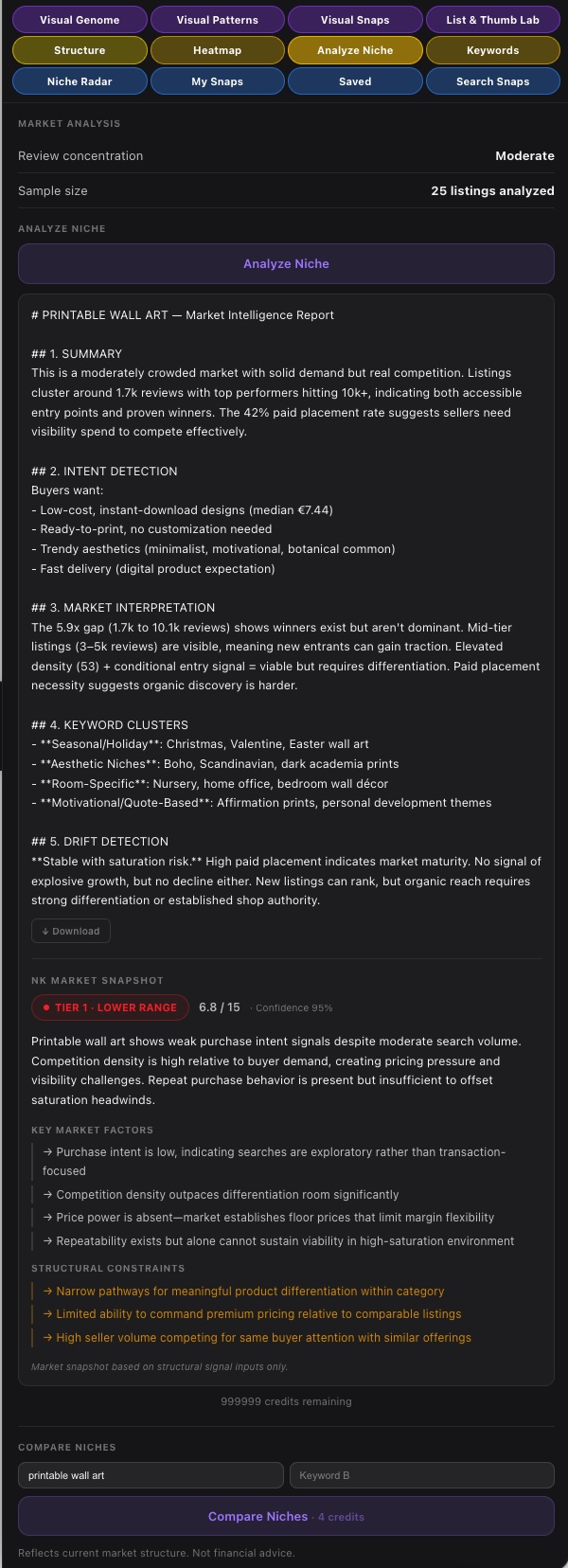
Key insightIf you’re entering Printable Wall Art today, do not compete on the broad keyword or on price. Purchase intent reads as exploratory rather than transactional, and the market sets a low price floor. Pick a defined aesthetic lane — vintage botanical, scientific/natural-history engraving, abstract minimalist, room-specific, or motivational — and own it through original, attributable design rather than another generic mega-bundle.
-
Why it mattersThe niche scores as Tier 1 — Lower Range at 6.8/15, confidence 95%. Competition density outpaces differentiation room, price power is largely absent, and repeatability alone cannot offset saturation. It is workable only with a strong, defensible angle and disciplined visual separation — not as a volume play on the generic term.
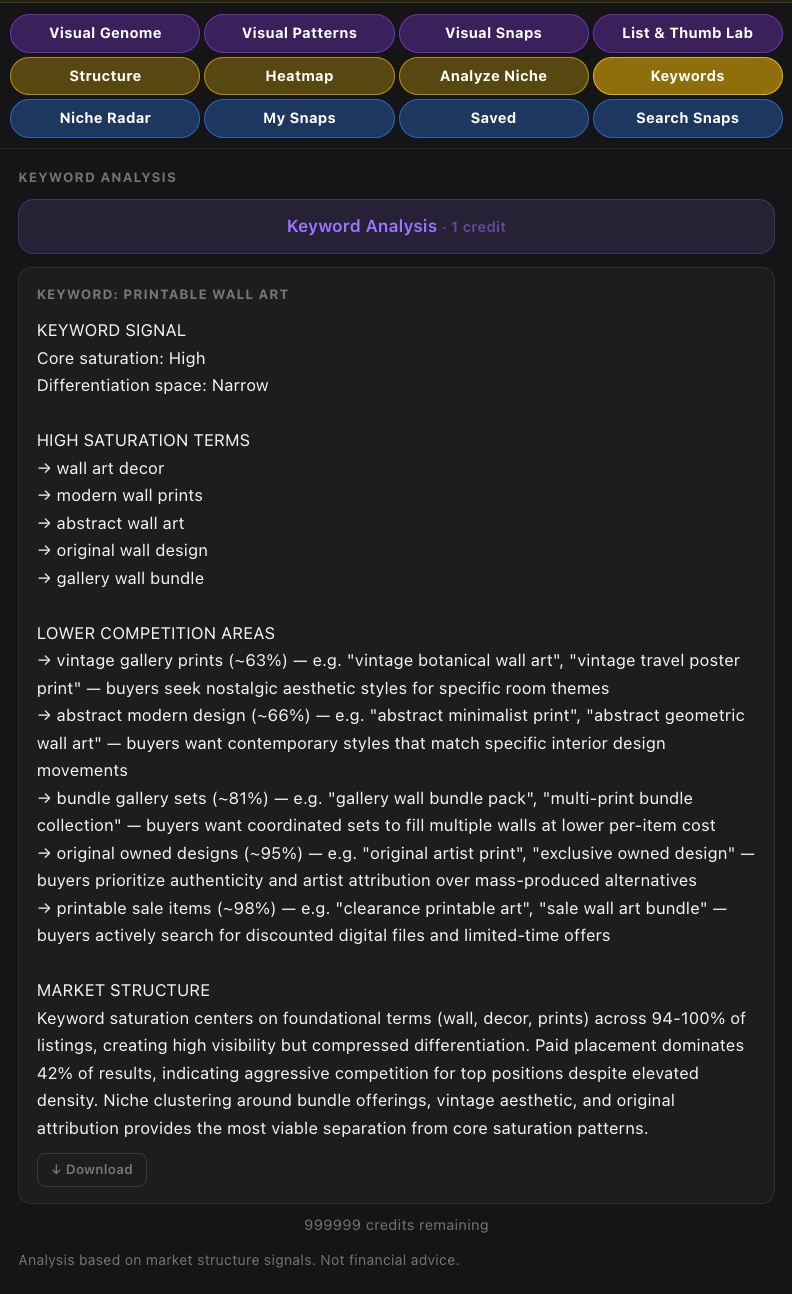
The vocabulary every listing already uses — and the narrower intent clusters that can create relevance.
-
What it measuresThe recurring language across titles and tags, plus the secondary modifiers that reveal why the buyer wants the print.
-
Key insightCore saturation is High and differentiation space Narrow. Foundational terms — wall art decor, modern wall prints, abstract wall art, original wall design, gallery wall bundle — sit across 94–100% of listings. The more useful openings are lower-competition clusters: vintage gallery prints (~63%), abstract modern design (~66%), bundle gallery sets (~81%), original owned designs (~95%) and printable sale items (~98%).
-
Why it mattersUse the broad phrase for baseline relevance, then let one coherent intent cluster define the listing. A title built around a specific aesthetic — vintage botanical, abstract geometric, or an original artist-attributed print — gives the buyer a reason to choose you over the mega-bundle beside you.
Understanding a market is half the equation. The other half is a thumbnail buyers actually want to click.
-
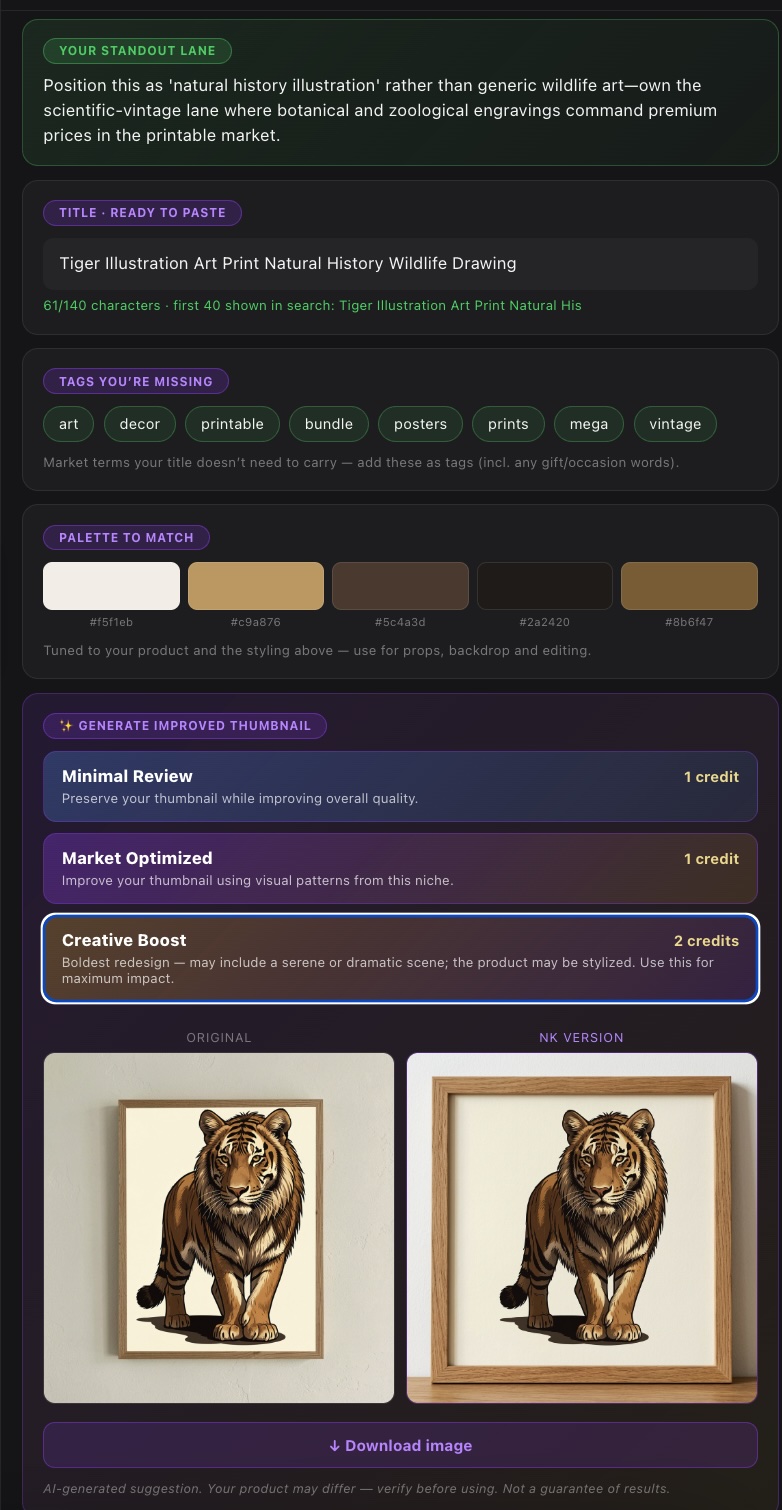
What it measuresThumb Lab uses this niche context — highly unified styling, very high scene detail and low polish — to improve how buyers experience the print without changing the actual product.
-
Three modesMinimal Review keeps your composition and improves clarity. Market Optimized aligns background, composition, lighting and colour with the niche. Creative Boost is for bolder redesigns, with the product preserved.
-
Why it mattersIn a market of busy collages, the fastest win is a single-subject frame shot: the print at actual scale, in natural light, showing frame edge and paper texture — clean isolation instead of another crowded gallery wall.
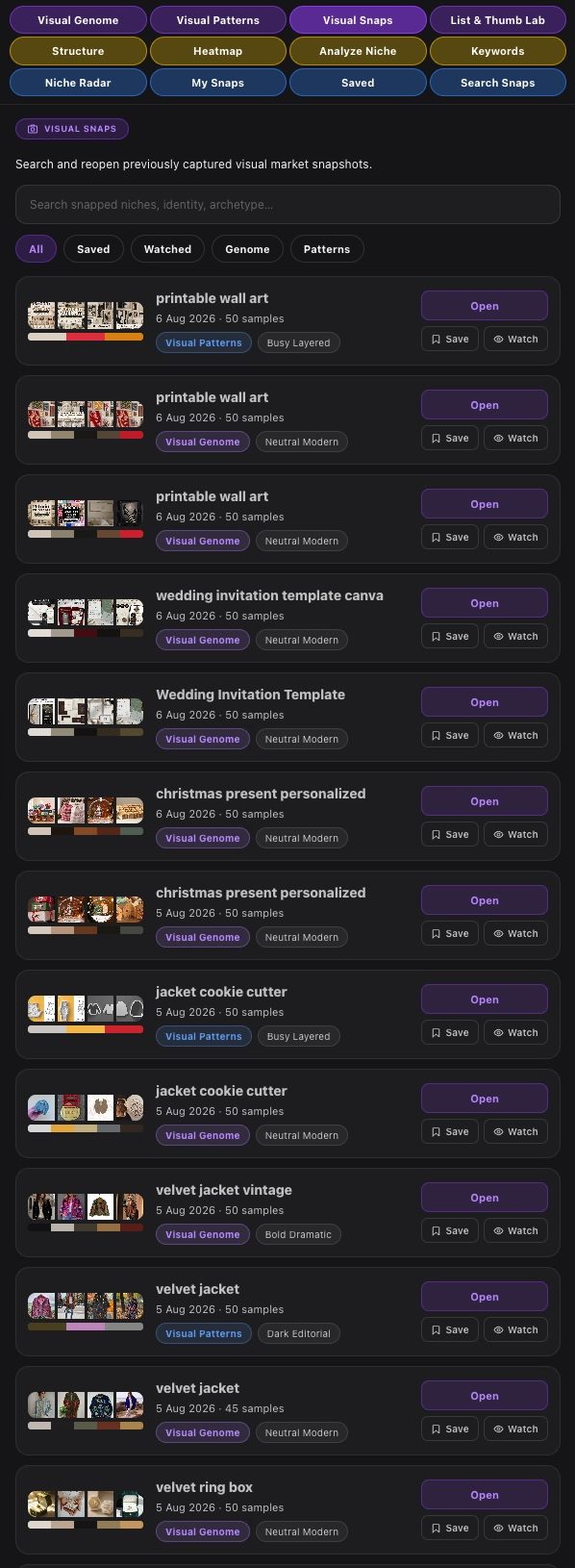
What the sample adds up to — and what it means for your next listing.
-
What we learnedThe visual field is highly unified and the market language is standardized. Busy lifestyle collages dominate, white and tan lead the palette, buyer intent skews exploratory, and a €7 median with a floor near €1 keeps price power minimal.
-
The bigger picturePrintable Wall Art offers a frictionless model and steady demand, but the sameness is the whole problem. The category is workable only for sellers who bring a genuinely distinct aesthetic and finish, not another entry into the mega-bundle stack.
-
The takeawayThe opportunity is in a defensible lane, not in volume. Owning one clear aesthetic — and looking unmistakably different in the thumbnail — matters far more than reproducing the category’s most common design.
This report was created using Niche Kompass, reviewing 64 Etsy listings for the keyword Printable Wall Art and visually analysing 50 sampled thumbnails.
Install the Niche Kompass extension and read any Etsy market straight from search — Visual Genome, patterns, structure and pricing.
No locked features. Every function is in both plans — they differ only in monthly credits.